
Analysis by: Dr. Nenad Stekić and Stefan Vladisavljev
Disclaimer: This article’s cut-off was October 27, 10.20 CET
Continuity of direction, break in method
The Student List’s victory will not reverse Serbia’s foreign policy direction, but it will decisively change how that policy is conducted. Serbia is now entering a phase of continuity of goals and discontinuity of method: military neutrality, non-imposition of sanctions on Russia and reliance on China over Kosovo remain, while personalised “summit diplomacy” gives way to an institutional, legally conditioned and more transparent approach. Relations with China would highly likely shift from “ironclad friendship” as one leader’s political brand towards a conditional partnership. The strategic framework is likely to stay intact. What changes is what lies beneath it: contracts, oversight, standards and the political price of opacity.
This piece starts from the facts available the day after the election held on October 25, draws on comparative experience of government change in countries with a large Chinese footprint, and ends with scenarios and probability estimates. The estimates should be read as analytical hypotheses, not certainties.
What we know: the mandate and the foreign policy programme
The Student List holds an outright majority, which is the single most important fact for foreign policy. According to the final CeSID and Ipsos projection, the list won 52.9% of the vote and somewhat 140 seats, while “Aleksandar Vučić – United Serbia” took 38.8% and 103 seats. A government needs 126 MPs, so the new majority does not depend on coalition partners. Vučić conceded defeat the same evening and announced he would continue the fight from opposition. He had earlier resigned the presidency in order to run for prime minister. The new majority’s candidate for prime minister is not yet known. The Student List’s foreign policy programme comes down to the following positions:
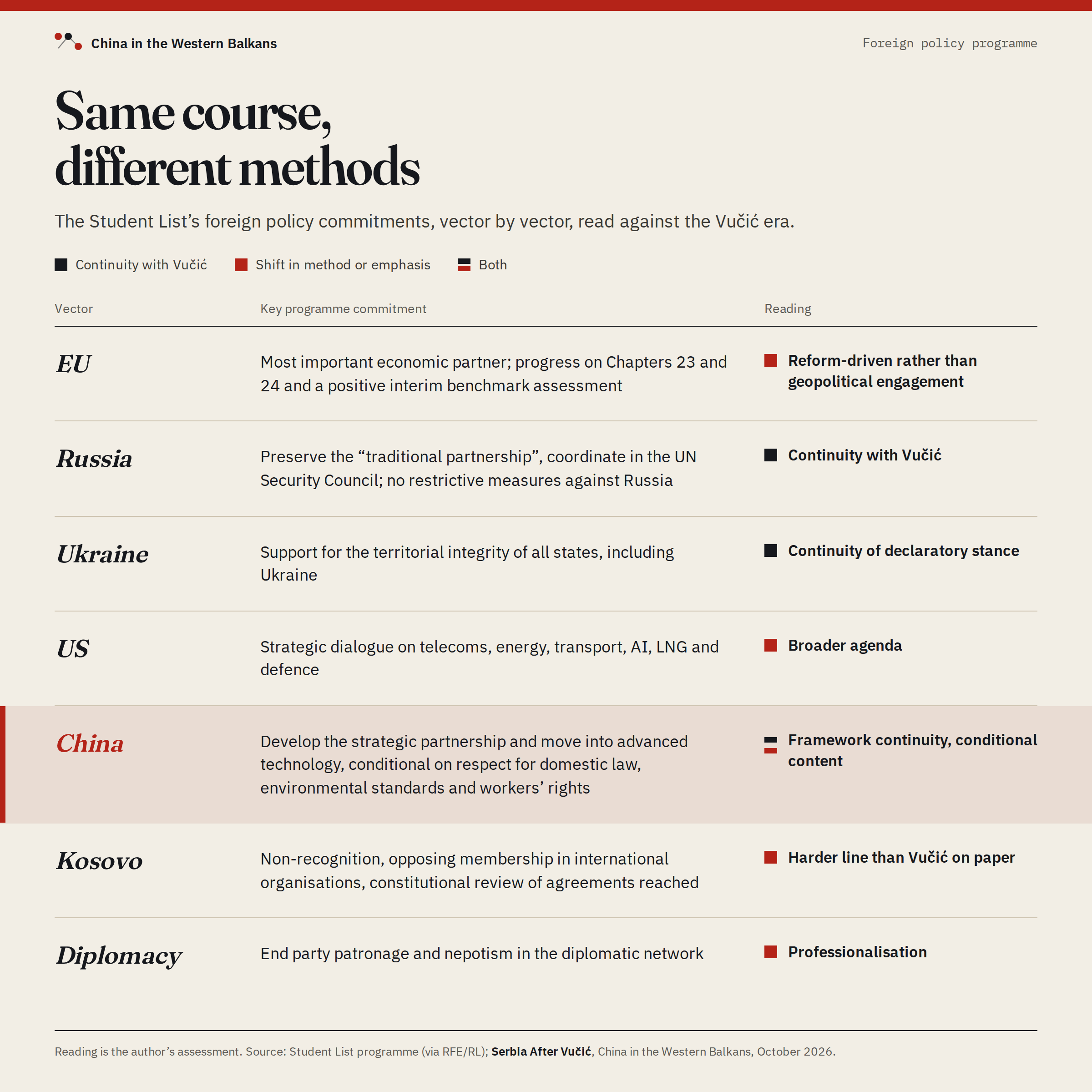
Source: Authors
The position on Russia sanctions was published in late September as part of the programme. Vučić’s claim that the new government will impose sanctions by spring is not supported by any document or statement from the Student List. Open question: who will take over the presidency and when, and whether Serbia will enter a period of cohabitation.
Structural constraints: why there will be no sharp turn
The new government’s room for manoeuvre is set by structures that predate Vučić and will outlast him. Small states in asymmetric relationships rarely change their foreign policy orientation after a change of government; they change intensity, style and the distribution of risk. Four constraints matter most for Serbia.
As long as non-recognition of Kosovo is a constitutional and programmatic commitment, Serbia needs two permanent Security Council members to block recognition at the UN. Those are Russia and China. The Student List’s programme is harder on Kosovo than Vučić’s practice, which increases rather than reduces the value of a Chinese veto. Dependence on Russian gas and the unresolved status of NIS mean that sanctions on Russia would carry a direct cost for households and industry. No government a few weeks into its mandate will take that risk without strong, concrete compensation from the EU.
The Student List won with a broad coalition of voters, including those who are culturally close to Russia and sceptical of the EU. Reactions to its sanctions stance show the list knowingly sacrificed part of its most pro-European electorate. Any sudden turn would break that coalition.
China is among Serbia’s top five export markets and its largest single source of imports, while the EU accounts for 58.3% of total trade. Chinese companies Zijin and HBIS have topped the list of Serbia’s largest exporters for years. This is a structural part of the export model, not political decoration.
A fifth, less visible constraint is institutional. An opposition of about 103 MPs, security and administrative personnel who worked for twelve years under the logic of personalised rule, and media close to the SNS will scrutinise every move towards Moscow and Beijing. Vučić has already set the frame: any change will be portrayed as betrayal. That pushes the new government towards caution on symbolic issues.
Relations with China: from personalised patronage to conditional partnership
Relations with China will be the new government’s most sensitive test, because this is where its foreign policy continuity collides with its domestic mandate. The student movement was born of the canopy collapse in Novi Sad, on a building renovated by a Chinese consortium. Yet the list did not build anti-Chinese rhetoric: its programme calls China Serbia’s most important trading partner in Asia and promises to extend cooperation into advanced technology.
Beijing’s reaction to the Student List’s victory could be described as a carefully calibrated hedge. It is not a congratulatory message but a reply to a journalist’s question, issued a day after von der Leyen and Costa congratulated the Student List on its victory.
It names no winner, and the “ironclad friendship” and “shared future” rhetoric of the Vučić era is replaced by a neutral “traditional friendship,” which signals a shift from leader-centred to state-to-state relations. The emphasis on “non-interference” is aimed at the perception that China backed the outgoing government, and “practical cooperation” based on “mutual benefit” is a coded reminder that contracts and projects are expected to be honoured.
That is especially sensitive given that the new majority grew out of protests over the collapse at the Chinese-reconstructed Novi Sad railway station. Beijing is signalling continuity, but the real test will be how the new government handles the Chinese project portfolio.
Under Vučić, relations with China were personalised (a leader-to-leader bond), politicised (China as proof of foreign policy autonomy) and opaque (contracts under the 2009 intergovernmental agreement, outside standard public procurement). The Student List’s programme targets the third element, and indirectly the first two. The condition of respecting domestic law, environmental standards and workplace safety is not boilerplate: it describes the existing points of dispute with precision.
Therefore, one could assume a shift from a relationship run through the president’s office to one run through ministries, regulators, prosecutors and the National Assembly. For Beijing this is not hostility, but it is the loss of a channel that solved problems quickly and out of public view.
Five points of friction
The canopy and the CRIC–CCCC consortium. The renovation contracts were kept secret because, according to an earlier ministry response, the Chinese partners did not want them published. The December 2024 indictment includes two CRIC employees, while the consortium maintains that the canopy structure was outside its contract. The Chinese embassy rejected claims that Vučić had promised Chinese contractors would not be held liable. The new government cannot avoid this issue, because it is the source of its legitimacy.
The 2009 intergovernmental agreement and contract secrecy. The mechanism that predates Vučić’s coming to power, but was heavily utilized by his government for direct award of work to Chinese firms will be reviewed. A more likely outcome than termination is continued use of the framework with mandatory publication of contracts.
Environment and labour: Bor, Smederevo, Zrenjanin. Zijin is the largest exporter and one of the most profitable employers in the country. The programme’s standards condition points to stricter inspections and fines, not to terminated contracts. With additional challenges coming from restrictive measures imposed by US administration on the premise of labur mistreatment.
Technology and surveillance. “Safe City” cameras and Chinese telecom equipment become politically more sensitive under a government that emerged from a movement that was itself under surveillance. The strategic dialogue with the US on telecoms and AI, announced in the same programme, points to gradual alignment with the European approach to network security.
Military cooperation. Existing Chinese air defence systems and drones remain in service. Large new procurements from China are unlikely, as they would open a front with the EU and US without clear benefit.
What stays
Three pillars stay: Chinese support on Kosovo in the UN Security Council, the free trade agreement in force since 2024, and the existing investment portfolio. Ongoing infrastructure projects also continue, but with reviews of costs and contracts. The “comprehensive strategic partnership” framework is unlikely to be formally changed; the language of a “community with a shared future” will probably quietly disappear from Belgrade’s official discourse. As a consequence, China remains an important partner but stops being a political project. It moves from the category of friendship into the category of interests, contracts and oversight. Beijing’s first reaction was quick and formulaic. Foreign Ministry spokesman Guo Jiakun stressed non-interference, respect for the people’s choice and readiness to work with the new government on the basis of equality and mutual respect. The formula is not empty: it signals that China accepts the change but expects “mutual respect” to include protection of existing investments.
China’s pattern after changes of government
Comparative experience shows that China rarely responds with coercion when a new government seeks to revise projects. Malaysia renegotiated the ECRL railway in 2019 and cut its cost by roughly a third, and the project went ahead. Montenegro, after its 2020 change of government, refinanced a Chinese motorway loan through Western banks without Chinese retaliation. Lithuania, by contrast, chose open political confrontation and paid a trade price.
Beijing tolerates contract revision and stricter standards, but punishes what it reads as an attack on its “core interests” (Taiwan, Xinjiang, Tibet, Hong Kong) or as public humiliation. The Student List’s programme touches none of these. There is therefore ample room for a rational settlement.
Hungary as a parallel
Serbia is the second of China’s two European “gateways” to change government in 2026. After Orbán’s defeat in April, Péter Magyar’s government announced a review of the Budapest–Belgrade railway project and launched an initiative to declassify project documents. China’s ambassador in Budapest nonetheless publicly expressed confidence in the long-term development of relations.
The Hungarian case is the best model for predicting Serbia’s: review and transparency at home, without tearing down the strategic framework. The difference is that Serbia is not an EU member and has no alternative source of finance on the same scale, so its bargaining position is weaker than Hungary’s.
For China, Serbia is the Belt and Road’s shop window in Europe. Coercion would confirm the Western “debt trap” narrative and weaken China’s position across the region. Thus some moderate patient pragmatism could be expected, as early contacts by the embassy and the CPC International Liaison Department with the new actors, an invitation for the new prime minister to visit Beijing, and offers in areas the new government itself highlights, such as technology and green energy.
The EU, the US and Russia: the frame in which China policy is decided
Policy towards China will not be shaped bilaterally but as part of a triangle with Brussels and Moscow. The key mechanism is what we call the logic of the cheaper concession.
The new government will be under pressure to show Western partners that the change of government has changed something in foreign policy too. Sanctions on Russia are ruled out by the programme and costly at home. Tightening standards on Chinese investment, technology and contracts, by contrast, is cheap domestically: it fits the anti-corruption mandate and does not offend voters close to Russia.
It is therefore expected that part of the Western pressure previously aimed at Russia to be redirected to China-related issues: network security, surveillance systems, foreign investment screening and transparency in public procurement. Paradoxically, China will pay part of the price for Serbia not sanctioning Russia.
Von der Leyen and Costa, in a joint statement, offered support for reforms on the rule of law, media freedom and the fight against corruption. The focus on Chapters 23 and 24 fits the Student List’s programme perfectly. This opens the way to rapid technical progress while the harder question of alignment with EU foreign policy is deferred.
In the long run, the path to membership carries a structural cost for relations with China: the bilateral free trade agreement would have to end on accession, because trade policy is an exclusive EU competence. That is not this government’s problem, but it is a horizon Beijing understands.
The US and Russia
The programme envisages a strategic dialogue with Washington on telecoms, energy, AI, LNG and defence. US interest in Serbia today is primarily transactional, focused on energy diversification and limiting Chinese technology. This is the area where Chinese and American interests will collide most directly. Russia has far stronger levers inside Serbian domestic politics than China: gas, the church, media and part of the electorate. China operates through capital and state institutions. That makes it easier for the new government to “normalise” relations with China than with Russia, which is why it is expected that the relationship with Beijing to be the first to undergo a visible review.
Scenarios and forecasts (to end-2027)
We do not own a crystal ball, but this does not prevent us from claiming the most likely outcome would be a high-quality conditional partnership: the strategic framework with China remains while its content tightens. The estimates below are subjective probabilities based on the programme, structural constraints and comparative cases.
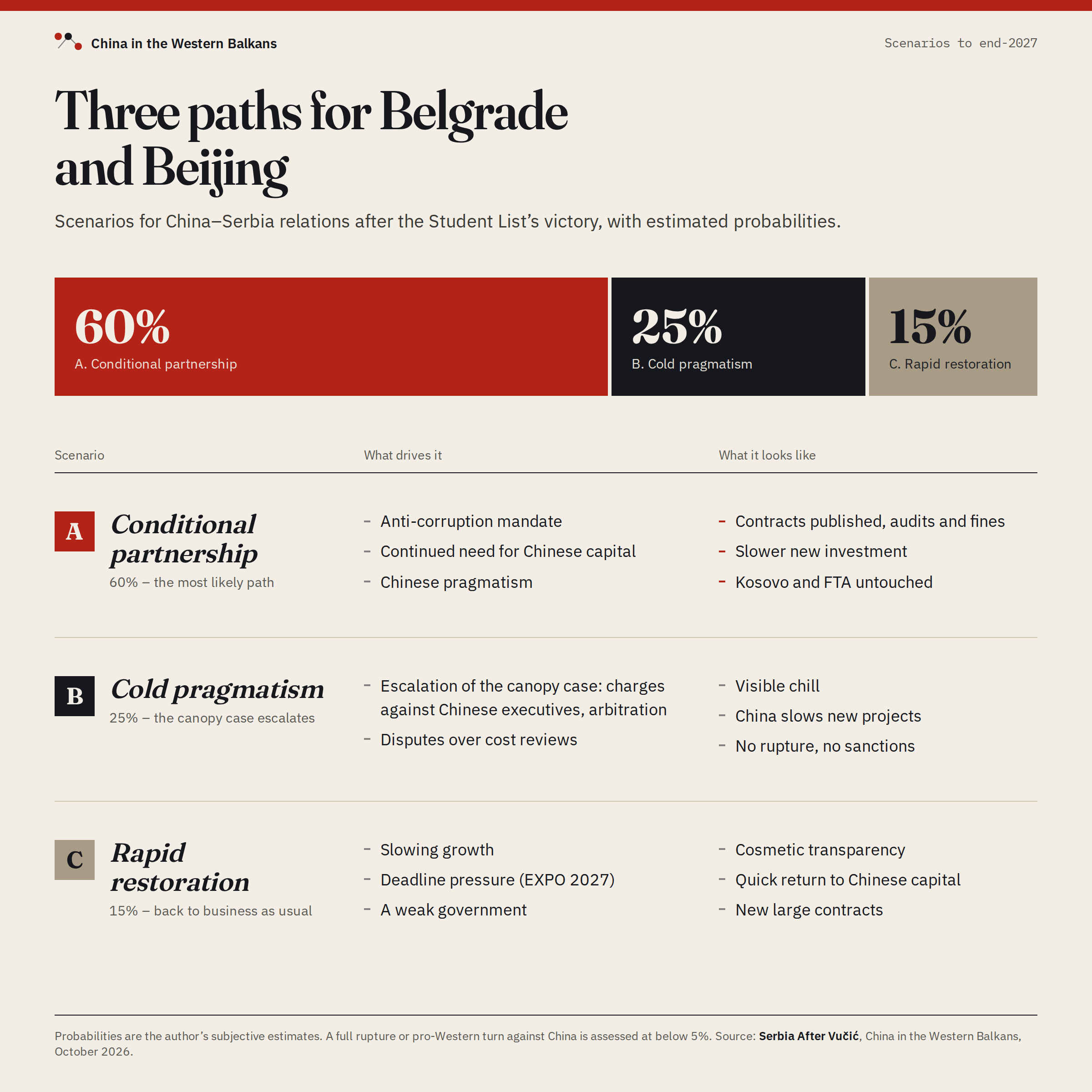
Source: Authors
A full rupture or a pro-Western “turn” against China is not realistic in this period (below 5%). There is neither a programmatic basis nor a social majority for it.
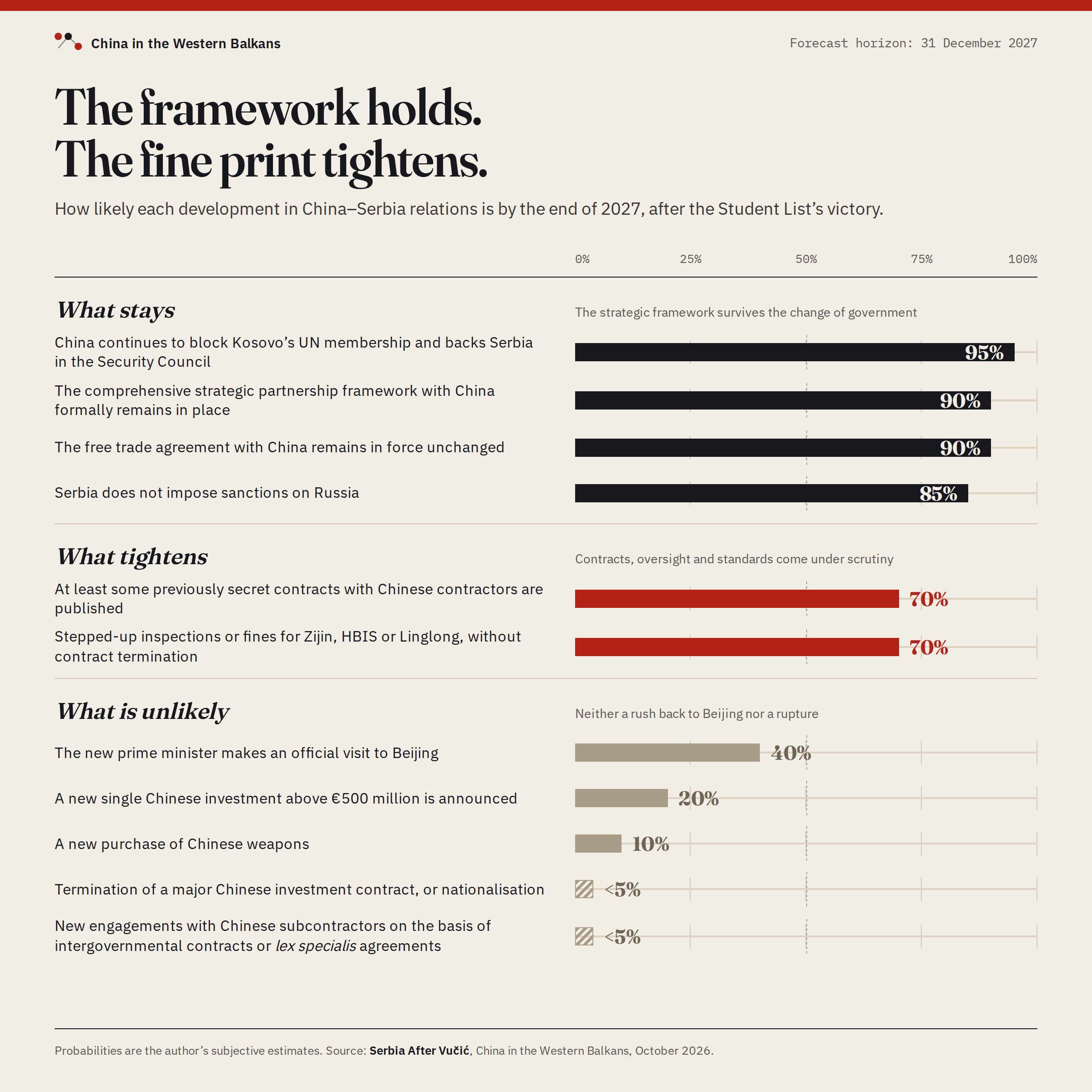
The biggest uncertainty is the canopy case. If the court process clearly points to the Chinese contractor’s liability and Beijing reads that politically, the outcome shifts towards scenario B. If China accepts the legal process as legitimate, the relationship could emerge from the crisis more stable than before. In this case, what remains to be seen and potentially can be used as a template for other cases which include subcontractors from China, but also other countries which have engaged with Serbia in this capacity.
Indicators to watch
A few early signals will show which scenario is unfolding, probably within the new government’s first hundred days.
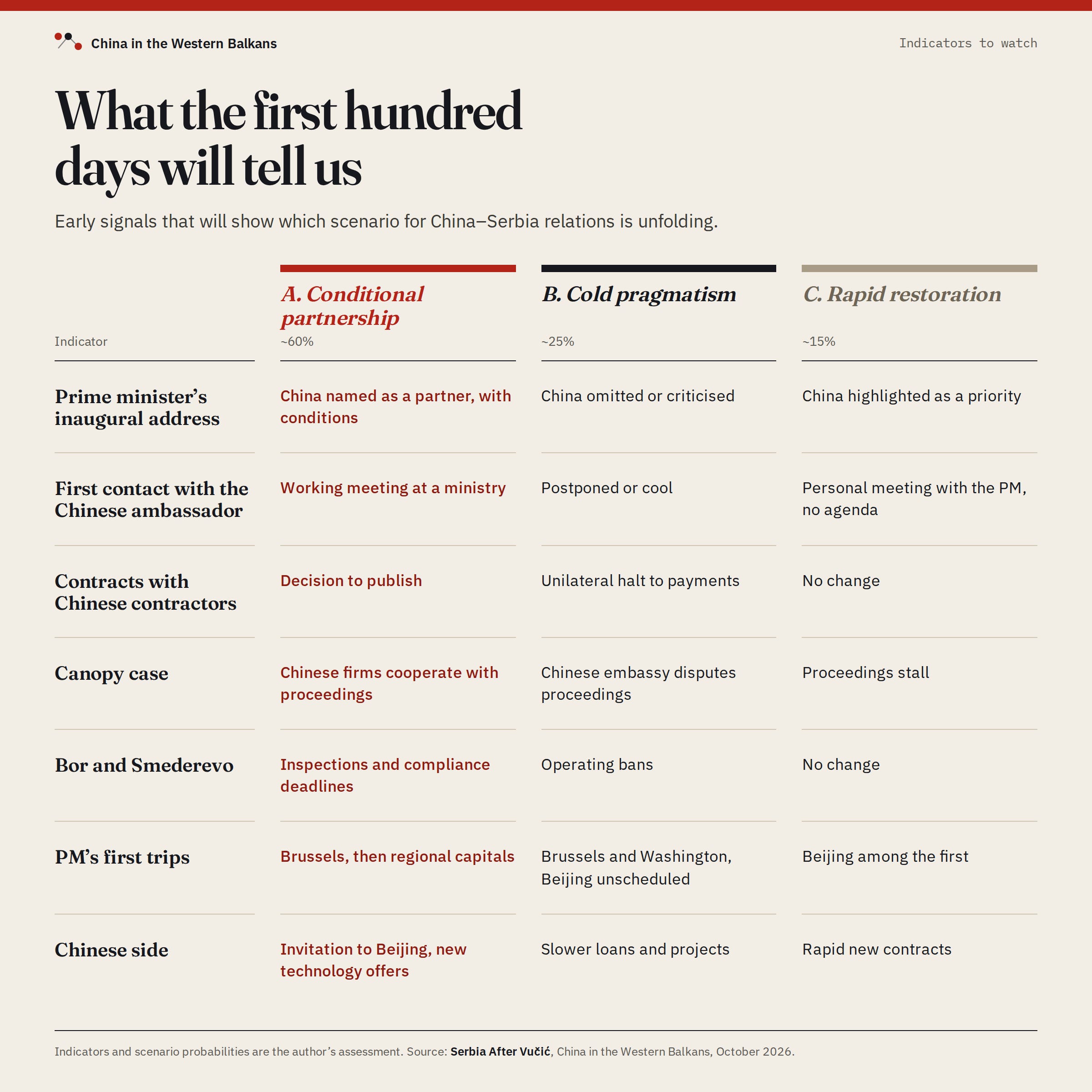
The language of official documents is also worth watching. The disappearance of phrases such as “steel friendship” and “community with a shared future” while “strategic partnership” is retained would be the clearest sign of scenario A.
Post-Vučić Serbia will not switch sides; it will change how it conducts policy towards all sides. The Student List has taken over the four pillars of foreign policy, but rejects the personalised and opaque practice on which those pillars rested.
For China, this means the end of a “special relationship” and the start of a normal one. That is not a defeat for Chinese policy: Beijing gains a more predictable partner but loses a privileged channel. The outcome will depend less on Belgrade than on whether China can accept that its companies in Serbia play by the same rules as everyone else. If this model proves stable, Serbia and Hungary could become examples of a new phase of China’s presence in Europe: less political symbolism, more contracts, oversight and accountability.
