
Analysis by: Stefan Vladisavljev
The war in Ukraine changed the European understanding of energy security.
For years, energy policy was primarily discussed through the language of prices, infrastructure and environmental sustainability. Since 2022, another word has become impossible to ignore: dependency. Europe learned, rather painfully, that the origin of energy matters. So does the ownership of infrastructure, the resilience of supply chains and the ability to replace one supplier when political circumstances change.
The response was not simply to find more gas. Through REPowerEU, the European Union accelerated diversification away from Russian fossil fuels and the transition toward renewable energy at the same time. Russian gas imports into the EU fell from 150 billion cubic metres in 2021 to 52 bcm in 2024, while renewables became an increasingly central part of the broader conversation about European strategic autonomy.
The same logic should apply to the Western Balkans.
Countries across the region urgently need new sources of electricity. Some remain heavily dependent on coal, others on hydropower vulnerable to changing weather conditions, while energy markets remain insufficiently integrated. Electricity demand will keep growing as economies develop and transport, heating and industry become increasingly electrified.
More renewable energy is therefore not merely a climate objective. It is an energy security objective. Solar and wind generation can increase domestically produced electricity, reduce exposure to imported fossil fuels and diversify the energy mix. The Energy Community increasingly treats renewable deployment, regional integration and security of supply as interconnected rather than separate policy objectives. No Western Balkan country can guarantee energy security entirely on its own, which makes both additional generation capacity and regional integration increasingly important.
But another question deserves more attention. As the Western Balkans diversify what produces their energy, are they sufficiently diversifying who builds, owns and supplies the infrastructure that produces it? This is where China enters the story.
China goes green in the Western Balkans
Chinese involvement in the Western Balkans energy sector is hardly new. For much of the previous decade, however, the discussion centred on coal-fired power plants, hydropower projects and large infrastructure deals backed by Chinese loans. The familiar model combined Chinese financing, usually from a state-owned policy bank, with a Chinese state-owned enterprise responsible for construction.
The renewable energy sector looks considerably more diverse. Between 2022 and 2026, Chinese companies became involved in wind, solar and hydropower projects across several Western Balkan countries, through very different arrangements. Sometimes Chinese companies are investors and owners. Sometimes they provide financing. Sometimes they build the infrastructure. Increasingly, they simply win commercial contracts for projects financed by European institutions or domestic investors.
Bosnia and Herzegovina illustrates the first model most clearly. Chinese investors acquired the 84 MW Ivovik wind farm, near Livno and Tomislavgrad, in 2022. POWERCHINA and China General Technology Group subsequently invested in and developed the project, which began producing electricity in October 2024. POWERCHINA describes Ivovik as the first energy project a Chinese company has invested in in Bosnia and Herzegovina, and its first wind-power investment connected to a European grid. Twenty Chinese-made turbines now stand there, with planned annual generation of roughly 259 GWh. This is no longer simply a Chinese company building Bosnian infrastructure; it represents Chinese participation in the ownership and operation of an electricity-generating asset.
Other Bosnian projects follow more familiar models. The Dabar hydropower plant combines Chinese financing with the involvement of China Gezhouba Group, while Chinese companies also appear in the Bistrica hydropower cascade and several solar developments.
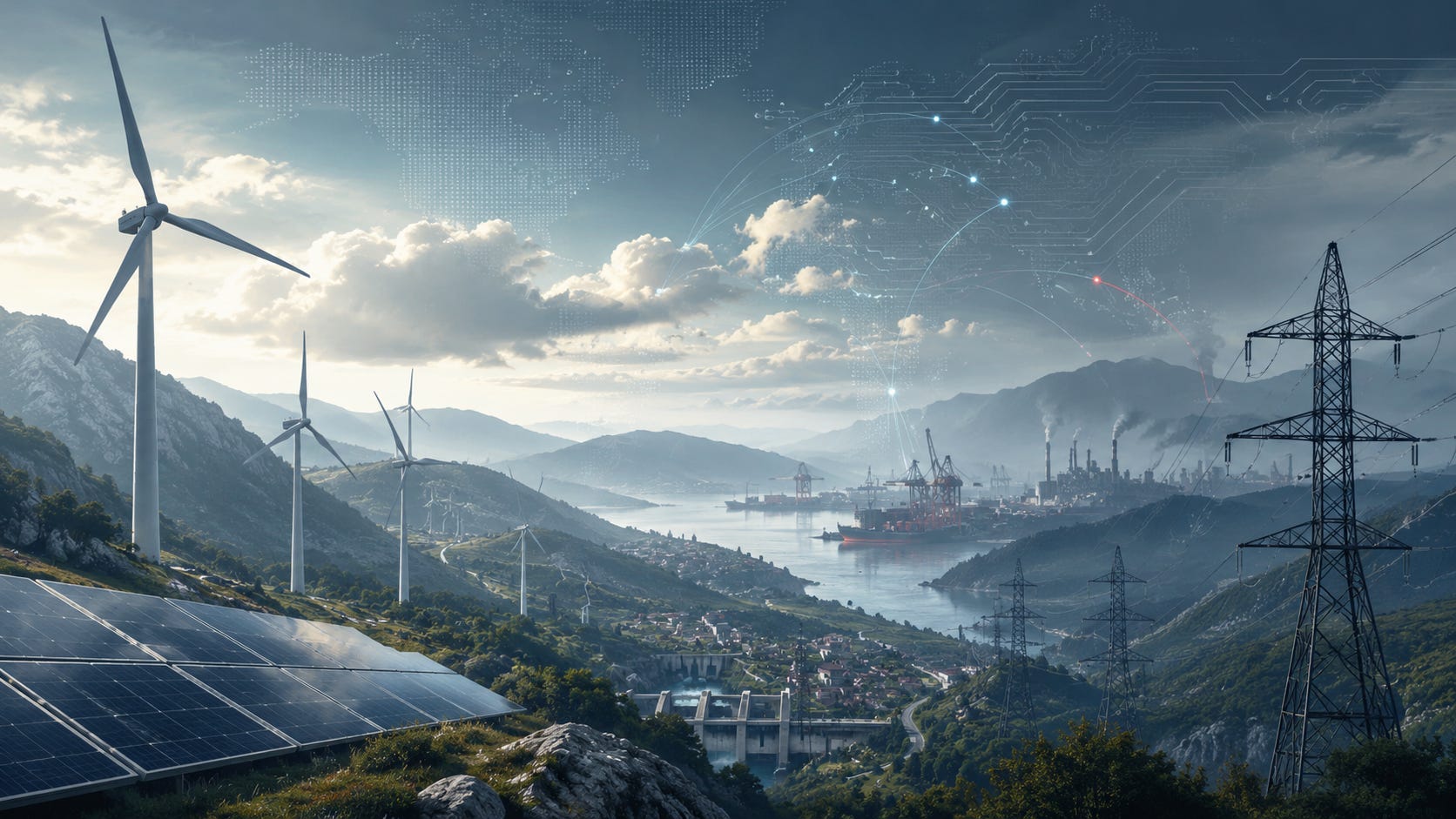
Serbia offers an even more interesting picture. In 2023, CWP Europe and POWERCHINA Resources signed an investment agreement for Vetrozelena, a 300 MW wind farm near Pančevo. Serbia’s Ministry of Mining and Energy welcomed the deal specifically in the context of energy diversification and security. The original structure envisaged POWERCHINA becoming the majority shareholder; by February 2026, POWERCHINA described Vetrozelena as its first controlling new-energy investment in Serbia, with construction moving into implementation. When completed, the wind farm is expected to become the country’s largest.
That is only part of a larger trend. Chinese companies have also been linked to the Crni Vrh wind project, the proposed Agrosolar Kula development, additional solar projects and turbine-supply agreements. Most ambitious is a 2024 memorandum covering roughly 2 GW of wind and solar capacity, accompanied by a green-hydrogen facility intended partly to supply Serbia Zijin Copper’s operations.
Individually, many of these projects make economic sense. Together, they show that Chinese participation in Serbia’s energy transition has moved beyond the model that defined the Belt and Road Initiative’s first decade. China no longer only lends governments money to build infrastructure; Chinese companies can now be investors, owners, developers, contractors and technology providers at once.
Not every Chinese project is Chinese-financed
The most interesting development sits elsewhere in the region. In Albania, the planned 12.9 MW floating solar plant at Vau i Dejës is financed through the European Bank for Reconstruction and Development and owned by the Albanian state electricity company KESH. Following an international procurement procedure, the design, construction and operation contract went to a consortium including Sungrow FPV, a Chinese company.
North Macedonia offers similar examples. Renewable projects backed by European financing have still involved Chinese companies as equipment suppliers or contractors: Chinese-made Goldwind turbines were selected for the Dren wind farm, and POWERCHINA has taken part in solar projects connected to the Oslomej and Bitola energy transition.
This distinction matters. For years, discussion of China’s economic presence in the Western Balkans focused mainly on Chinese loans. That approach is increasingly insufficient, because a project does not have to be financed by China to expand the commercial or technological presence of Chinese companies. And this is not necessarily a problem. A Chinese company winning an open tender under EBRD rules because it submits the strongest technical and financial proposal is fundamentally different from a closed bilateral arrangement awarded without competition. It may even say something positive about the evolution of Chinese companies themselves: many have become competitive enough to operate within procurement frameworks set by European financial institutions.
But it also means that understanding Chinese involvement requires looking past headline figures for Chinese lending or foreign direct investment. The more relevant question becomes: where in the energy value chain are Chinese companies becoming difficult to substitute?
Dependency does not disappear when the energy becomes green
An uncomfortable paradox sits at the centre of the global green transition: renewable energy can increase national energy independence while simultaneously creating new external technological dependencies.
China today holds an extraordinary position in global clean-energy manufacturing. According to the International Energy Agency, China accounts for around 85 percent of solar supply-chain production capacity and roughly 80 percent of lithium-ion battery production capacity, with an even higher share of some upstream components, including around 95 percent of photovoltaic wafers.
There are good reasons for this. Chinese producers are extraordinarily competitive. Large-scale manufacturing, industrial policy, technological development and lower production costs have pushed down the global price of solar technology dramatically; cheap Chinese panels have arguably accelerated solar deployment worldwide more than almost any international climate conference. Western Balkan countries should benefit from that. Rejecting competitive Chinese technologies simply because they are Chinese would make the energy transition slower and more expensive, and that cannot be the objective.
Governments should not, however, assume that replacing dependency on imported fossil fuels automatically produces energy security. Consider a country that successfully reduces its dependence on imported gas and coal by rapidly expanding domestic solar and wind generation. That outcome is unquestionably positive. But if a large share of the generation assets belongs to companies from a single country, if turbines, inverters, batteries, digital management systems and replacement components predominantly come from the same industrial ecosystem, if maintenance relies on the original provider, and if public authorities cannot identify the ultimate beneficial ownership behind important energy companies, a further question follows. The country has diversified its energy source. Has it diversified its strategic exposure? That is a different question, and one regional policymakers are only beginning to ask.
This is where resilience matters
The answer should not be to treat every wind turbine or solar panel as a geopolitical threat. Energy security discussions can easily drift in that direction, particularly as competition between China, the United States and the European Union intensifies, and that drift would be a mistake. The nationality of an investor should not automatically determine whether an investment is beneficial or dangerous: a European, American, Gulf or Chinese investment can create vulnerabilities if the institutions surrounding it are weak.
A more useful approach asks structural questions instead:
Who owns the asset, and is beneficial ownership transparent?
How was the contract awarded, and was it competitively tendered?
Could another company maintain or repair the technology if needed?
Are critical digital systems adequately protected?
Could the country replace the supplier if relations deteriorated?
Is one company becoming dominant across several segments of the energy system?
Does the investment comply with environmental, competition and state-aid standards?
Does today’s investment decision increase or reduce the country’s ability to integrate into the European energy market tomorrow?
These questions apply regardless of whether the investor comes from Beijing, Brussels, Abu Dhabi or Washington. China’s scale, though, makes them particularly relevant. The issue is not one wind farm in Bosnia and Herzegovina or Serbia; an 84 MW or 300 MW project does not by itself create geopolitical dependence. The potential vulnerability comes from concentration. If the same external ecosystem gradually supplies financing, equity investment, engineering, turbines, solar modules, batteries, software and long-term maintenance, the cumulative relationship becomes more strategically significant than any individual contract suggests. And unlike a highway or a bridge, energy infrastructure remains part of a country’s critical system every day after construction ends.
Different countries, different exposure
Chinese renewable-energy involvement remains highly uneven across the Western Balkans, and the regional picture should not be exaggerated. Bosnia and Herzegovina and Serbia clearly represent the most significant cases between 2022 and 2026. Albania and North Macedonia show a different form of penetration, centred more on equipment supply and commercially awarded contracts.
In Montenegro, Chinese companies have expressed interest in renewable investments, but no comparable utility-scale Chinese-backed renewable project has yet emerged in the same period. The picture in Kosovo is broadly similar: major current renewable projects have predominantly involved European and other Western financing.
There is, in other words, no single “Chinese renewable energy strategy in the Western Balkans” producing identical results everywhere. Domestic procurement choices matter. Access to European financing matters. So does the ability of individual governments to attract competing investors. That may be the most important lesson of all.
Diversification needs to mean diversification
The Western Balkans need more investment in energy, not less. The transition away from coal will require billions of euros. Electricity grids need modernisation. New solar and wind capacity needs connecting. Storage will grow more important, and cross-border connections need strengthening. Closing the door to Chinese companies would be neither realistic nor useful.
But opening the door without considering strategic concentration would repeat the mistake Europe made with Russian energy, in a different form. Energy security should therefore be understood broadly: it means diversifying fuels and generation technologies, but also diversifying investors, financing sources, technology providers and supply chains. It requires competitive procurement and transparent beneficial ownership. It requires investment screening capable of distinguishing an ordinary commercial transaction from the acquisition of genuinely strategic infrastructure. And it requires governments to recognise that the lowest construction price does not necessarily capture the full strategic value, or strategic cost, of an energy project that may operate for the next thirty years.
Chinese companies can, and probably will, play an important role in the Western Balkans’ renewable-energy transition. Their capital, technology and construction capabilities can help the region build infrastructure it urgently needs, and that can strengthen energy security. The challenge is ensuring it does not simultaneously weaken resilience.
The real objective should not be replacing one dependency with another, or choosing between China and the West. It should be ensuring that no external actor becomes indispensable. If the lesson of Europe’s energy crisis after 2022 was that diversification matters, the Western Balkans should apply that lesson not only to where their gas comes from, but to the infrastructure that will power their economies for decades to come.
The China angle is real but secondary. The bigger worry is state capture from EU green subsidies themselves. Carnegie flagged this last year. Crony capitalists don't need Beijing to game the transition.